Showing posts with label Asian Dessert. Show all posts

Blue Glutinous Rice Cakes (Pulut Tai Tai) Recipes

I always wanted to make this Chinese Baba Nyonya wedding specialty cakes. It is called Pulut Tai Tai or Blue Glutinous Rice Cakes. The blue stain comes from a flower name Bunga Telang or Blue Pea Flower. Since I still have some of the dried blue pea flowers given by Sonia I decided to made some when my friend Choy’s and her family came to our house for dinner not too long ago Traditionally, this cakes are served with kaya (coconut egg jam) and you can find the recipe here.

Ingredients:

600g glutinous rice – wash and soak overnight
350 ml coconut milk
150ml warm water
4 pandan leaves
1 tsp salt
2 tbsp sugar
12 - 15 blue pea flowers – soak in some warm water,crush it to extract the blue coloring.

1. Wash the rice and divide it into two equal portions. Soak one part in water and another part in the blue pea flowers juice. Leave them overnight. Soaking the rice overnight will help in steaming process.
2. Drain both the rice; put them side by side on into a steaming tray. Warm the coconut milk, sugar and salt into the microwave for 30 seconds. Stir and mix well.

3. Drizzle in about half of the coconut milk into the rice. Arrange the pandan leaves on top of the rice and steam the rice over rapid boiling water for 10 minutes.
4. Remove the steaming tray, put the pandan leave aside, fluff up and mix both rice together and drizzle the balance of the coconut milk, put the pandan leaves back on top of the rice again and continue to steam for another 15 minutes or until the rice is done.
5. Remove the steaming tray; discard the pandan leaves, even out the rice with a spoon, and using a banana leaf or aluminum foil press down the rice until well compact.
6. If possible put something heavy (I used can food) to weigh down the rice. Leave it to cool.
7. Slice the rice cakes and serve it with coconut jam.


I am submitting this dish to Muhibbah Malaysia Monday
For more details please refer here

Seri Muka II/Glutinous Rice Layer Cake Recipes

I’ve posted this before but it is a different recipe. I did some changes to the recipe and also tinted the glutinous with some bunga telang(butterfly pea or clitorea ternated) given to me by Sonia when I went back to Malaysia early this year. This flower which was used to blue the rice in nasi kerabu (rice salad) or nyonya kueh but now many of them just used the blue coloring. To obtain the color from the bunga telang, the blooms are dried in the sun before storing. When required, they are soaked in water to allow the color to seep out and subsequently, obtain the rich blue color. My friend Sue given me some seeds and I planted it during summer. I think I planted it a bit too late and by the time it started to flower it was already late summer so I didn’t get much flowers out of it. I kept quite a bit of seeds for my next season planting.


No sure why but the plants have more leaves than flowers.


Ingredients:

600 gram glutinous rice - wash and soaks the rice overnight
300 ml thick coconut milk
1 tsp salt
10 dried bunga telang/blue clitorea flower (soak in a bit of hot water, mash and squeeze it to extract a deep dark blue hue)


Custard topping:

3 eggs
130 gram sugar
3 tbsp custard powder
2 tbsp flour
300 ml thick coconut milk


1. To make the rice layer – drain the rice well. Combined the rice, coconut milk and rice and mix well. Pour it into a well greased 8” x 8” pan and steam over high heat for 30 minutes or until rice is cooked.
2. Remove from heat, fluff up the rice with a fork and drizzle the blue flower juice all over the rice. Press the rice with a banana leaf or aluminum foil to compact and level the surface. Set it aside.
3. To make the custard layer, combined all the ingredients and mix well. Strain into a saucepan to remove any lumps. Cook over low heat, keep stirring until mixture slightly thickens. Remove from heat and pour the mixture over the glutinous rice. Cover the top of the pan with a piece of foil and steam it over medium heat for 30 minutes.
4. Remove from heat and let it cool complete before cutting into it.

Note: To get a smooth and even top layer you have to steam it over medium heat and if not you will get bumpy and wrinkle layer. I do have some extra seeds for this flower and if anyone interested and you can email me your name and address and I will mail it to you.

I am submitting this dish to Muhibbah Malaysia Monday
For more details please refer here

Guiling Gao/Black Herbal Jelly Recipes

This herbal jelly also known as Guilin Gao is made of Chinese herbs. It has been treated as medication in the ancient time in China. It's also said to help nourish our yin and clear body heat, while cleansing the body blood of toxins, help improves or cures skin disorder, improving the metabolism rate, relieving cough. I am not sure how true this is but I like it a lot especially the refreshing and slightly bitter taste and the cooling effect. Now this herbal jelly has become a popular dessert and it is usually serve with sugar syrup or honey.


Ingredients:

3 packet/30 gram of the guiling gao powder
½ cup cold water
800 ml boiling water
Some sugar/honey syrup


1. Dissolve the powder into the cold water. Stir well. Pour the boiling water into jelly mixture and stir well. You will notice it will starts to get thicker.
2. Pour it into small serving bowl and let it cool. Once it is cool leave it to chill in the fridge.
3. Serve with sugar syrup or some honey.

Angku Kueh/Steamed Glutinous Rice Cake with Sweet Filling Recipes

I made a lot of western dessert but sometimes I like our good old traditional Kueh too. Carlos is not a fan of it so sometimes it is difficult to make it just for myself. I am glad some of my Malaysian friends love it as much as I do so I get to make it with them. I made these Angku kueh with a friend of mine not too long ago.

Angku Kueh known as red tortoise cakes in Hokkien dialect is a common breakfast item among Chinese Malaysian or Singaporeans. As the name says, it is shaped like the shell of a tortoise because it was believed then, that eating these long-living creatures would bring longevity to the person eating it. It is also a must have on special occasions like celebrating the first-month of newly born baby, wedding days, birthdays etc for the Chinese.

Basically the skin of the AngKu Kueh is made from sweet potatoes and glutinous rice flour. You can put fillings like red bean paste, mung bean paste, coconut or roasted peanuts into it. A good angku kueh is one where the skin is thin, soft, and chewy and a nice contrast with the sweet fillings. We were pretty satisfied with the angku kueh we made as the skin turn out well and the filling is not too sweet. Here are some pictures taken when we were making these to share it with you.


Ingredients for the dough:

300g sweet potatoes - cut into chunks
180 g glutinous rice flour
2tbsp rice flour
2tbsp sugar
3tbsp vegetable oil
some water (to bind the dough together but if your sweet potatoes are soft you might not need it)


1. Steam sweet potatoes till soft, takes about 20 minutes.
2. Use a potato masher or a fork, mashed the cooked sweet potatoes, add in glutinous rice flour, rice flour, sugar, and oil, slowly add in water bit by bit to form a soft dough, cover and set it aside and rest for 30mins.
3. Shape into 30g small ball (depend on the size of your mould)

Ingredients for Mung Bean filling

250g mung beans/green beans – wash and soak overnight in cold water
130g sugar
3tbsp vegetable oil

1. Drain dry the mung beans, place the beans on a steaming tray and steam over medium heat until soft. It should take about half an hour.
2. While beans still hot, place beans, sugar and oil in a food processor, process till fine and become a paste.
3. Shape into 10-12g balls (depend on the size of your mould) and set it aside.

To make the Angku Kueh

Some banana leaves – cut into round shape
A bit of oil for brushing

1. Grease the angku kueh mould by brushing on some vegetable oil.
2. Flatten the sweet potato ball, place a mung bean ball to the center and shape it into a round ball.


3. Place the ball in the mould, press evenly, then knock to relased the dough and place on greased banana leaf.
4. Arrange on a steaming tray and steam for 10mins over high flame. Take it out from the steamer and brush it lightly with some oil.


Note : Different sweet potatoes will have different texture and water content. Some you might need to add more water to the dough and some you might need to add more glutinous rice flour to it.
Nate and Annie from House Of Annie will be hosting the September event. They have set up a form for all submissions.

Steamed Fruit Cake Recipes

Christmas is still a long way to go and why am I a baking fruit cake? Oh well, I am trying out one or two recipes now and if I like it I will bake it for the coming Christmas. I will usually use my old fruit cake recipe but I am a bit bore with it so I want something different this year. Today I tried out the famous CMG Kek Kukus Buah Buahan or Steamed Fruit Cake . I aged this cake for a few days before cutting into it. This cake is really moist and full of caramel flavor but a bit too sweet for me. If not it will be perfect. So the next time I make this I will cut down on the amount of sugar. I have another half of the cake left and will try it out in a few weeks time and see if there is a different in taste.


Ingredients:

375 g mixed fruits (I used raisins, currants, cranberries, pineapple, papaya and apricots)
250 g butter
150 g brown sugar (I used light brown sugar)
3 large eggs
¼ cup almond flakes (I used walnuts)


Sieved together:

300 g  flour
1 tsp bicarbonate of soda
1 tsp cream of tartar
1 tsp of nutmeg (I omit this)

For the Caramel

150 g sugar

1. Line and greased a square or 9” round baking pan. Prepared the steamer. Sift all the dried ingredients and mix in the dried fruits and set it aside.
2. Cream brown sugar and butter until light and fluffy. Add in the eggs, one at a time and beat well. Slow down the mixer and add in the flour and fruits. Mix well and turn off the mixer.
3. In a small saucepan and over medium heat melt the sugar until it turns golden brown. Turn on the mixer again to slow speed and slowly drizzle in the hot caramel into the cake mixture. Mix well.
4. Pour batter into prepared pan and cover the top of the pan with aluminum foil (to prevent water from dripping into the cake while steaming). Steamed over high heat for 4 hours (I steamed only for 3 hours). Remember to check the water level of your steamer every now and then and please add only hot water to the steamer.


Note: Please be careful when you drizzle in the caramel as it is very hot. If you are using dried apricots, pineapple and papaya you have to chopped it up first.

I would like to this opportunity to wish all my Muslim friends and readers “Selamat Hari Raya Aidil Fitri” Hope you all have a joyous celebration with your family and friends back home. Most importantly, drive safely to your destination.

Bibingka Cassava Recipes

Bibingka Cassava is a tradition Filipino dessert. This dessert is very similar to our Malaysian Kuih Bingka. The traditional bibingka will have a cheese or custard topping to it but I omitted that. I prefer it plain. For me the taste of this bibingka is a cross between mochi and kuih bingka . I was surprised that Carlos didn’t turn away from this dessert. I think it is because this dessert was baked and not steamed.

Ingredient A

2 pounds grated cassava
1/2 cup fresh grated coconut
3 eggs
3/4 cup coconut milk
3/4 cup evaporated milk
1/4 cup Mochiko flour/glutinous rice flour
4 tbsp melted butter


Ingredients B

120 gram sugar
120 gram gula Melaka/palm sugar/brown sugar
A few drop of yellow coloring (optional)


1. Preheat oven to 350F degrees. Line and greased a baking pan or any type of mould or pan you are using
2. In a large mixing bowl, combined all the ingredients A and mix well. Divide the mixture into two equal amounts. Mix one portion with sugar and a few drop of yellow coloring. And the other one with the gula Melaka/palm sugar.
3. Pour one portion of the mix into the baking pan or mould and bake for 20 minutes. Take out the pan and pour the remainder portion on top. Let it bake for another 40 - 45 minutes or until the top is dry and firm to touch.If you are using the donut pan, the 1st portion will take 10 minutes and the second another 15 min to bake.
4. Remove from oven and let it cool completely before serving.

Wife Biscuit/Sweetheart Cake/Lao Por Peng Recipes

Wife Biscuit/Sweetheart Cake is a traditional Chinese pastry with flaky thin skin and the filling made with winter melon and sesame seeds. This pastry is originated from Hong Kong but now you are able to buy it from almost all the Chinese Bakery. So how does the name of this pastry come about? There are quite a few stories out there and one of them is this.

In ancient China, there was a poor couple. They adored and loved each other, staying in a small village. When a mysterious disease spread, the husband's father became very sick. Although they tried really hard to raise money to provide treatment for him, it wasn't enough. Sadly, the wife decided to sell herself as a slave, exchanging herself for her father-in-law's medicine. Once the husband learned about what his wife did, he made a cake filled with winter melon and with a crispy crust in honor of his wife. However, his cake became so popular that he was able to earn enough money to buy his wife back

I wanted to make this biscuit for the longest time but I can’t seems to find ‘koh fun’ here in the US until one of my blogger friend told me that I am able to get it from the Asian Store in PA. Making the pastry takes a bit of work but the end result was fantastic. The pastry is flaky and the filling has a great fragrant of sesame seeds and the right sweetness from the winter melon. This is really addictive that I don’t think you can stop by just eating one. Here is the recipe adapted from Corner Café with some minor changes.

Ingredients for Water Dough:

70g bread flour
70g  flour
25g caster sugar
55g  shortening
70ml water, adjust as necessary


Ingredients for Oil Dough:

70g flour
35g shortening

Winter Melon Filling:

200g candied winter melon (tung kua/ 糖冬瓜)
3 tbsp roasted white sesame seeds
3 tbsp of dry coconut
30g (1 1/2 tablespoons) sugar
40g (4 tablespoons) cooked glutinous rice flour (Koh fun/ 糕粉)
1/2 teaspoon salt
1/2 teaspoon vegetable oil
55ml water

1 beaten egg for egg wash
Some sesame seeds – for sprinkle

1. Prepare water dough: Combine all flours and sugar in a bowl, rub in shortening to a crumbly stage. Slowing add just enough water to form a soft and non-sticky dough. Knead until smooth. Shape into a ball and wrap with plastic wrap. Rest for 30 minutes. Divide into 14 equal portions.
2. Prepare oil dough: Rub shortening into flour and knead to form soft dough. Rest for 30 minutes then divide into 14 equal portions.
3. While the dough is resting, prepare the filling: Finely chop together candied winter melon, sesame seeds and grated coconut. Transfer to a bowl and add sugar, glutinous rice flour, salt and oil. Stir to combine. Slowly add just enough water to form a ball. Divide the filling into 14 portions. Roll it into balls.
(pix A)
(Pix B)
(Pix C)

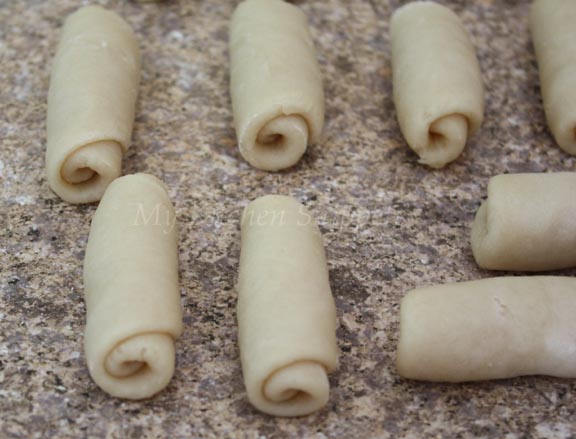
4. Take 1 piece of oil dough to wrap inside 1 piece of water dough and seal well. Be sure to wrap tightly and eliminate any air pocket. Flatten the dough with your palm then roll it out into long oval thin dough using a rolling pin (pix A). Roll the dough up like a Swiss roll (Pix B and C).

(Pix D)
(Pix E)
(Pix F)

5. Turn the dough 90° (pix D), flatten it and roll it out thin (pix E). Then roll it up like a Swiss roll (pix F)  Repeat step 4-5 with the remaining dough)

(Pix G)

(Pix H)
6. Take 1 piece of pastry dough, press down the center of the dough (Pix G) and pinch both ends (Pix H) together then flatten it so the dough is roughly round shape. Roll the dough out to a circle.

7. Wrap in 1 piece of filling and seal tightly (be sure no air pocket inside). Flatten the wrapped pastry with your palm the roll it out slightly to 1/3 inch thick. Repeat the same steps with the remaining pastry.


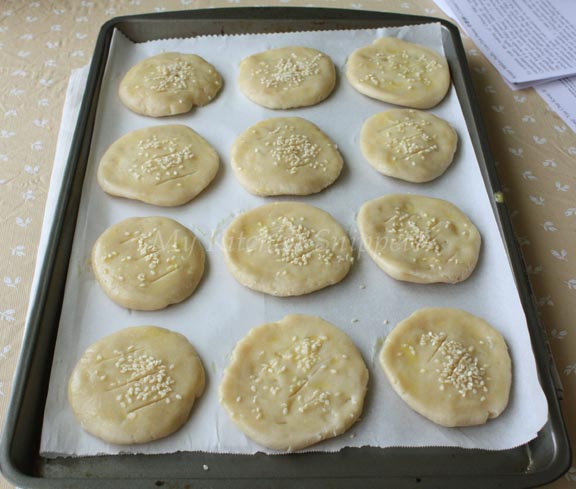
8. Cut 2 - 3 parallel slits on the top (seal side down), brush with egg wash and sprinkle with a bit of sesame seeds. Place pastries on a baking sheet and bake in preheated 400°F oven for 16-18 minutes or golden brown.

Milk Pudding Recipes


We are experiencing some severe heat wave here on the East Coast and the temperature sore up to upper 90’s and someday over 100 degree for the past few weeks. In the weather like this I tried to lay off cooking and baking as much as possible and all I want is to drink and eat something cooling and sweet. This milk pudding is such a nice treat for all of us in this scorching heat . No relief in sight yet. Crazy it may sound but I wish it is winter now :)


Ingredients:

600 ml water
120 gram sugar
8 gram agar agar powder
3 pandan leaves
300 ml milk
200 ml coconut milk
A few drop of pandan paste


1. In a medium size saucepan bring the water, agar agar power and pandan leaves to boil. Let it boil for 3 minute until agar agar power.
2. Add in sugar; continue to stir until sugar dissolved. Lastly pour in the milk and coconut milk. Turn down the heat and bring the mixture to a slow simmer. Turn off the heat and remove the pandan leaves.
3. Remove ¾ of the mixture and add in a small drop of pandan paste. Pour into prepared pan or mould. Let it set before pouring the balance of the agar agar (white portion) mixture on top. Let it set and serve cold.